One of the 300 Sieger Crew-Owned Covers
The Story
Realizing there may be a market for space flown philatelic items, Herman E. Sieger of Lorch, Germany, a major European stamp dealer, set out in 1970 to recruit an Apollo crew to carry a small number of postmarked envelopes - called "covers" by collectors - to the moon.
In pursuit of his idea, Sieger approached H. Walter Eiermann, a naturalized American citizen, who had been privately employed for many years in the Cape Kennedy area and was well acquainted with many in the astronaut corps. Sieger became acquainted with H. Walter Eiermann while on a visit to Cape Kennedy in 1970.
Eiermann, working on Sieger's behalf, was able to interest the crew of Apollo 15.
In the spring of 1971, during the Apollo 15 crew-training period at Cape Kennedy, Eiermann proposed to Scott, and later to Worden and Irwin, that the astronauts carry 100 special covers to the lunar surface for him. It is the contention of the astronauts that there was to be no commercialization or advertising of these covers and that nothing would be done with them until after completion of the Apollo program. In return, Eiermann offered a monetary consideration, approximately $7,000 apiece, in the form of savings accounts in a German bank. The astronauts agreed and also decided to carry 300 similar covers for themselves, 100 for each, but two were destroyed before the flight, making a total of 398 that were flown.
Due to weight constraints, NASA required that all the items carried aboard the Apollo spacecraft be manifested. Although the Apollo 15 crew was later to claim an innocent oversight, the covers, which were carried in Scott's spacesuit pocket, were not recorded pre-flight.
It is important to note that the Personal Preference Kits (PPKs) for the Apollo 15 crewmembers were packed and stored aboard the spacecraft days before their launch to the moon, so these covers could not have been packed if they were to have a launch day post office cancellation. The 400 covers were hand delivered to the post office (HQS Bldg.) at Kennedy Space Center just after midnight the morning of the launch. The mission launched at 1:34 pm that afternoon. There was a postal employee working late there and had the covers machine cancelled, as requested from the astronaut support office, even though the liftoff of Apollo 15 was planned for 9+ hours away. Once the special cachet envelopes were processed in less than 15 minutes or so, the batch of covers were brought to a nearby facility, the Manned Spacecraft Operations Building (also known as the Operations and Checkout Facility), where the batch of covers were vacuum packed so that the bundle was not thicker than 5 cm. Next, they were sealed in fireproof Teflon-coated fiberglass, and delivered to Launch Complex 39A's White Room after Scott and his crewmates had arrived at the pad for their final launch preparations and spacecraft entry. While there, Scott received the special package and put the small bundle into one of his leg-pockets of the spacesuit he had on.
After splashdown, aboard the USS Okinawa, the Apollo 15 recovery ship, the astronauts purchased twin eight-cent stamps and affixed them to these covers. The covers were then canceled and date-stamped August 7, 1971, their landing date, in the shipboard post office. The astronauts later autographed these covers while flying from Hawaii to Houston on Aug. 31, 1971.
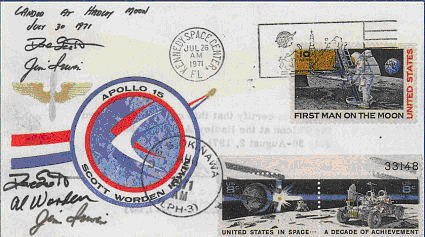
100 of these covers carried the handwritten notation, "Landed at Hadley moon July 30, 1971. Dave Scott, Jim Irwin", and the additional legend - "This is to certify that this cover was onboard the Falcon at the Hadley Apennine, Moon, July 30-August 2, 1971" typed on their backs and signed by a notary public. It was these covers that later came on to the commercial philately market in Europe.
On September 2, 1971, Scott mailed the 100 specially certified covers to Eiermann, who at that time was in Stuttgart, Germany. Eiermann delivered these covers to Sieger. Sieger paid Eiermann an unspecified sum for the covers and then advertised them for sale. By November 1971, ninety-nine of them had been sold at an average price of $1,500 each.
When the news of the sale reached the United States, Scott telephoned Eiermann to request that sales be stopped and the covers returned but he was unsuccessful. In February 1972, in an effort to save their careers and reputations, the astronauts decided not to accept the money and Scott took steps to assure that the funds were returned to Eiermann. Eiermann suggested, as an alternative to the savings accounts, that each astronaut receive a commemorative stamp album for their families. This suggestion, initially accepted by the astronauts, was rejected in April 1972 after further consideration and the astronauts returned the $7000 they had each received. However a Congressional investigation wanted to make an example of the Astronauts and so NASA had no choice but to suspend them from active flight status. NASA also confiscated the 298 covers. It is unfortunate because there might never have been a problem if Sieger had honored the agreement not to offer the covers for sale until the Apollo program was completed.
To prevent similar incidents from occurring again, NASA drafted rules as to what astronauts would be allowed to take with them into space. Future crewmembers would be bound not to publicize the contents of their "Personal Preference Kit" (PPKs) until they retired from the corps. The astronauts were also required to sign an agreement restricting transfer of their flown memorabilia to gifts and donations - sale of memorabilia was strictly prohibited.
In 1983, eleven years later, the U.S. Postal Service announced plans to fly 260,000 covers aboard the space shuttle. Al Worden, seeing the similarities between his confiscated covers and those set to fly on STS-8, sued the government for the return of his crew's 298 covers. In an out-of-court settlement, the covers were returned to the crew. Upon their receipt, the entire crew drafted, signed and had notarized a letter of provenance for each cover, which today has become an integral part of their lore.
Identification
The 398 unauthorized covers (initially 400 but two destroyed) are lightweight onion skin envelopes carrying as a cachet, a replica of the official Apollo 15 patch overprinted with an Air Force wing and propeller emblem. They were part of a large order of covers paid for by a privately employed public relations man with a wide circle of friends among the NASA astronauts.
The 398 covers were properly packaged for flight and carried on board Apollo 15 by Scott in a pocket of his space suit; each having been canceled at the Kennedy Space Center Post Office early on July 26, 1971, the morning of the flight.
There are differences in appearance between Sieger's 100 covers and the 298 Sieger/Crew Owned covers, including different combinations of stamps that were affixed.
The 100 Sieger covers have a handwritten inscription on their front upper left corner stating:
LANDED AT HADLEY MOON
JULY 30 1971
(signed Dave Scott & Jim Irwin)
On the reverse is a typed and notarized inscription that reads:
This is to certify that this cover was onboard the Falcon
at the Hadley-Apennine, Moon, July 30-August 2, 1971
Notary stamped and signed Mrs. C. B. Carsey. Her notary raised seal is also applied to the cover.
Also on the reverse, in the lower left reverse corner, Sieger's name "H.W. Sieger" is stamped then signed by him below a handwritten serial number.
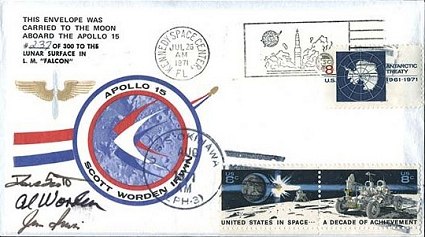
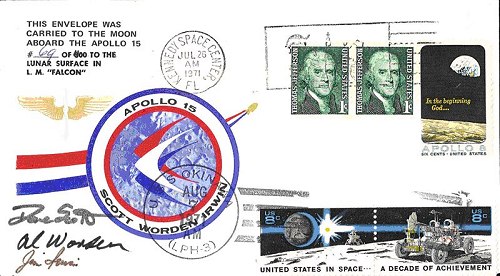
In comparison, the 298 Sieger/Crew Owned covers have the following inscription printed on their front upper left corner:
THIS ENVELOPE WAS
CARRIED TO THE MOON
ABOARD THE APOLLO 15
#____ OF 300 TO THE
LUNAR SURFACE IN
L. M. "FALCON"
Although images of all 298 Sieger/Crew Owned have not been reviewed, it seems that the handwritten correction in the upper left corner, changing 300 to 400, stopped somewhere between 69 and 100. We will have to monitor this as other covers come to market.
All the covers are also autographed by the crew on the front lower left corner.
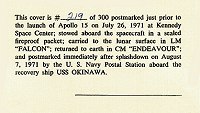
Some of the Sieger/Crew Owned covers have a small (unflown) card inserted inside the cover, some signed by a crewmember, that reads:
This cover is #____ of 300 postmarked just prior to the launch of Apollo 15 on July 26, 1971 at Kennedy Space Center; stowed aboard the spacecraft in a sealed fireproof packet; carried to the lunar surface in LM "FALCON"; returned to earth in CM "ENDEAVOUR"; and postmarked immediately after splashdown on August 7, 1971 by the U. S. Navy Postal Station aboard the recovery ship USS OKINAWA.
Finally, in the upper right corner of the reverse of the Sieger/Crew Owned covers, not the Sieger 100 covers, is the small handwritten initials of S. Neil Hosenball (SNH), NASA's general counsel, and a serial number, which NASA assigned at the time of their confiscation. The Sieger/Crew Owned covers are numbered 1-298 and the 60 impounded Phases of the Moon covers taken from Worden are numbered 299-358.
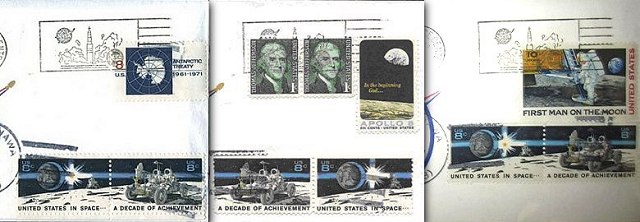
Shown above are three different stamp combinations for the flown Apollo 15 Sieger / Crew-Owned covers
A Hierarchy of Desirability
As these treasured Covers have trickled onto the market over the last 30 years, collectors have had the opportunity to closely examine their nuances. In doing so, many collectors have determined a hierarchy of desirability. In other words, if given a choice, which Covers would be considered the most desirable. Basically, the Covers seem identical, but here are some considerations:
- Look closely at the twin "Decade of Achievement" stamps at the lower right of each cover. Although the twin stamps are separate stamps depicting separate images, put together they show one complete contiguous image. The left image is of the Earth and LM in the background and the right image shows Scott and Irwin in the Lover rover. When properly positioned the lunar surface as well as the trail in Space align together, and there is no gap between the two images.
So imagine the astronauts aboard the recovery ship affixing stamps. They just wanted to complete the task of getting the stamps put on the Covers and not really considering the configuration. Look at the images shown above. The right and left Covers depict the proper and most desirable stamp configuration. The center Cover shows the stamps in the wrong order. And there are also examples where the individual stamps were affixed (not attached together) in both the incorrect and correct order.
- Then there is the issue of the single stamp in the top right corner. It seems that the Earthrise and the First Man stamps top the list of popularity. The Antarctic Treaty stamp, having nothing to do with Space or the Moon is least desirable. Some feel that the Earthrise is most desirable, not just because of the iconic image, but also due to the extra two Jefferson 1 cent stamps that had to also be affixed to complete the required postage, which required yet more effort on the part of the crew.
- Next is the serial number consideration. Low serial numbers are always considered most desirable by collectors no matter what the collectible is. Covers numbered 99 or less (2 digits) would be considered most desirable. Also, as noted above, the first covers certified by the crew also had the handwritten correction in the upper left that changed the number to 400 from the printed 300. The highest number with handwritten correction found thus far is 94., so we will speculate that Covers numbered 100 and under have the handwritten correction.
- The card insert. Although unflown, many of the covers have this insert inside the Cover that again displays the serial number. A very few of them are also signed by a crew member. A signed insert card would be most desirable, however the fact that it was not flown and not seen within the Cover, these remain least important.
Collector Commentary and Observations
In the final analysis of what makes a rarity desirable and in high demand and valuable, it is some combination of the story, the circumstances and the "sizzle" It is not always about numbers or scarcity. In creating the hierarchy of flown covers, the 214 Flown Apollo 11 Covers have always been the most sought after because of the fact that they accompanied the first men to land on the Moon. And, due no less in part to man's fascination with scandal and controversy, these Flown Apollo 15 Sieger Covers have to come in second as the story line reads like a movie script. One also has to consider that the effort put forth by the crew to make these covers what they were was unprecedented, with the post office cancellations, the affixing of the stamps, the certifications; both on the covers and the later notarized letters. Considering that most astronauts today will comment that the only thing on their minds during training was to get home alive and that they paid very little attention to the unimportant stuff, like how many of this or that was on board the spacecraft, it seems notable how much effort was expended. What a story!
Other covers flown on Apollo 15
For the record, in addition to the 398 Apollo 15 Sieger and Sieger/Crew Owned Flown covers, the following covers, which were properly authorized and manifested, were carried aboard the command module and flew in lunar orbit:
-
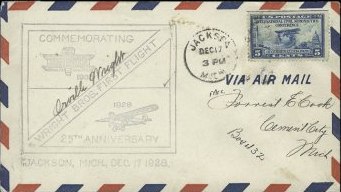
1 Wright Brothers commemorative cover dated 1928 and autographed by Orville Wright (shown on the right), which was carried by Worden for a friend.
The cover was sold at auction in 2007 (see annex E).
-
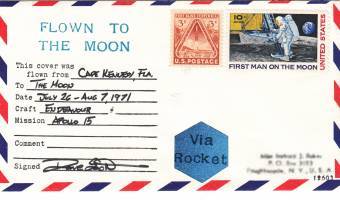
1 cover labeled "flown to the Moon" bearing a First Man on the Moon stamp and a Bliss Centennial three-cent stamp, which was carried by Irwin for a personal friend of Apollo 12 astronaut Richard Gordon.
Addendum by Chris Spain (2015): The cover is now illustrated on the right, and seems to have been carried by Scott rather than Irwin. A stuffer (apparently unflown) was included with the cover
on which Scott again identified the envelope as having been flown on the mission for the recipient.
-
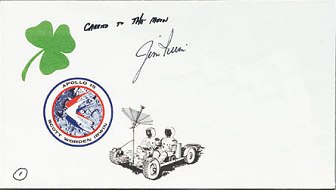
8 covers (now referred to as the Shamrock Covers) imprinted with a green shamrock, a small Apollo 15 emblem and a rendering of the Lunar Rover with two astronauts, bearing the notation, "Carried to the moon - Jim Irwin," which were carried by Irwin. Each is numbered (1 through 8) within a circle in the lower left front corner . Apollo 15 was the first mission to utilize the Lunar Rover.
Irwin was of Irish decent and he held an affection for that, which is why he carried these particular covers.
(see annex D).
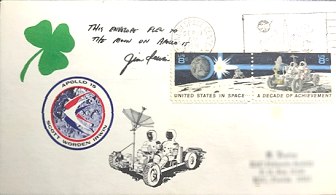
Addendum by Chris Spain (2019): According to evidence submitted to the hearing into the Apollo 15 stamp scandal[1] one of Irwin's 8 Shamrock covers was given to Forrest J. Rhodes, who ran the postal facility at KSC, and one to Ray Burton, the president of the Kennedy Space Center Philatelic Society.
One of these two covers is shown on the right, and unlike the Shamrock cover shown above, it is inscribed by Irwin "This envelope flown to the moon on Apollo 15", and has two 8c Decade of Achievement stamps affixed along with a Sep 29, 1971 KSC cancelation (apparently the day Irwin visited the KSC to gift the covers).
Irwin retained the other 6 covers and it seems that these have the appearance of the Shamrock cover shown at upper right - with no stamps affixed, and likely numbered 1 through 6 by Irwin at a later date.
Addendum by Howard C. Weinberger (2020):
In the 1970's, a professional golfer named Jim Lawler, of Irish decent, befriended Jim Irwin and helped him and Mrs. Irwin with a few things. In appreciation, they gifted him one of the Shamrock Covers. The serial number of this cover is not known.
-
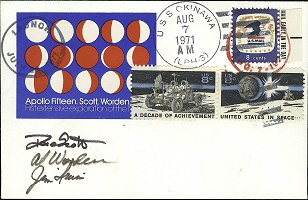
One of the flown "Phases of the Moon" covers
144 Apollo 15 covers that were created by German stamp dealer F. Herrick were carried by CMP Al Worden in his command module PPK. All of the 144 covers were affixed with a special printed cachet sticker showing 15 phases of the moon.
Naturally, the covers have gone on to be known as the Phases of the Moon covers. It has been erroneously reported in earlier writings that only 100 of the 144 were affixed with the Phases of the Moon sticker, but Al Worden is emphatic that all of them were Phases of the Moon covers.
On the USS Okinawa, the Apollo 15 recovery ship, the astronauts affixed two eight-cent Decade of Achievement stamps and one U.S. Mail eight-cent stamp, which were purchased on board by Worden, on each of the covers and then had the covers canceled with the recovery date by the shipboard post office. The astronauts later autographed these covers while flying back from Hawaii to Houston. There are no Phases of the Moon covers with a KSC launch date cancellation and any such covers are suspicious and should not be considered genuine. The only post office cancellation is the August 7, 1971 USS Okinawa cancellation.
Worden sent all 144 covers to Herrick for finalizing and safekeeping after his return.
Herrick and his son stamped the covers, after the mission, with the launch and recovery dates. The launch and recovery stamps are not official post office cancellations but rubber stamps created by Herrick. There were at least two variations of the launch stamp, one oval and one circular, and just one variation of the recovery stamp, which was circular. Herrick was not consistent with the application of these stamps. Some covers have the launch stamp on the front and the recovery stamp on the reverse while others have both stamps on the reverse. Other combinations are possible. Some stamps are in red ink while others are in black.
When word came of the NASA investigation into the carrying of the covers, Worden instructed Herrick to return them all to him. According to Herrick he personally sold three of his covers, had sent several to Europe for eventual sale, and had sold ten more through a dealer on commission. It was Herrick who also claimed that 16 of the covers were torn or damaged and were destroyed, but only he could confirm that as Worden had not been witness to that. In the end, Herrick only returned 60 of the 144 covers to Worden, which were then impounded by NASA. Years later, after their release back to Worden, he sold most of them to pay off the remaining debts he amassed during his 1982 U.S. Congressional run.
Only the 60 covers that were returned to Worden, of the 144 originals, were impounded by NASA. NASA was unable to get hold of the 84 that Herrick might have had or sold, which means that only Worden's 60 impounded covers have the desirable serial number and initials of S. Neil Hosenball (SNH), NASA's general counsel, under the flap on the reverse. The numbering sequence for the Phases of the Moon covers ran from 299 - 358, leaving off from numbers 1 - 298 assigned to the Sieger Crew Owned covers. Furthermore, only these 60 covers also have the accompanying notarized letter that is signed by the entire crew which explains the story of the covers. The letter is similar to the notarized Sieger/Crew Owned cover letter. It differs in that it states that these were flown in lunar orbit and not to the surface as the Sieger/Crew Owned covers did. The letter incorrectly states that the covers were post office canceled on the day of launch, which they were not. There are a few covers which exist that also are accompanied by a separate Al Worden letter that corrects this fact. Obviously, the most desirable would be one of the 60 Worden covers with both letters .
To date, no information has been developed indicating that there were agreements or arrangements between Herrick and Worden whereby Worden was to have received anything of value from any sale of the covers by Herrick.
-
2 U.S. Postal Service covers, one of which was publicly canceled on the Moon by Scott at the request of the U.S. Postal Service; the second cover, a backup, was not taken to the lunar surface. Both covers have been returned to the Postal Service (in Washington, D. C.)
-
87 Apollo 12 covers (initially thought to be 88) that did not fly on that mission and which were carried on Apollo 15 by Irwin for Barbara Gordon, wife of Apollo 12 astronaut Richard Gordon. These are detailed on the main Apollo Flown Covers page.
|
Annex A: Flown Apollo 15 Sieger covers sold at auction or identified in private or museum collections
| Number | Stamp | Sold via | Lot no. | Sale Date | Price | Reference / Notes |
|
| 5 | First Man | Eppli | 981734 | Mar 22 2019 | TBD | One of Sieger's 100 covers ; Auction listing  |
|
| 12 | First Man | RRAuction | 5232 | Apr 18 2019 | UNSOLD | |
|
| 16 | First Man | Superior | 544 | May 3 1997 | $5,980 | One of Sieger's 100 covers |
| Heritage | 50054 | Jun 13 2025 | $13,125 | Auction listing |
|
| 31 | First Man | Heritage | 50247 | Dec 6 2024 | $17,500 | One of Sieger's 100 covers ; Auction listing |
|
| 44 | First Man | RRAuction | 477 | Nov 20 2014 | $55,654 | One of Sieger's 100 covers ; Auction listing |
|
| 51 | First Man | Vaccari | 1123 | May 7 2011 | UNSOLD | One of Sieger's 100 covers |
| RRAuction | 9407 | Oct 23 2015 | $16,115 | Auction listing |
|
| 54 | First Man | Felzmann | 8316 | Nov 7 2014 | $11,957 | 9,600€. One of Sieger's 100 covers |
|
| 56 | First Man | RRAuction | 264 | Apr 28 2015 | $24,663 | Auction listing |
|
| 57 | First Man | Heritage | 52112 | May 20 2016 | $18,750 | Auction listing |
|
| 60 | First Man | RRAuction | 7335 | Apr 17 2025 | $18,089 | One of Sieger's 100 covers ; Auction listing |
|
| 84 | First Man | Facebook | n/a | May 31 2019 | $30,000 | Asking $30k ; Auction listing |
|
| 99 | First Man | Astro-Auction | n/a | Apr 2 2006 | $8,900 | One of Sieger's 100 covers ; Auction listing |
| RRAuction | 515 | Nov 29 2012 | $9,799 | Auction listing |
Annex B: Flown Apollo 15 Sieger Crew-Owned covers sold at auction or identified in private or museum collections
The first column below gives the serial number assigned by the crew as noted on the front of the cover.
The second column gives the NASA serial number noted on the back of the cover, where known.
| Number | NASA S/N | Stamp | Sold via | Lot no. | Sale Date | Price | Reference / Notes |
|
| 4 | 097 | Antarctic | RRAuction | 442 | Apr 15 2015 | $10,110 | Auction listing |
|
| 13 | 088 | Antarctic | Swann | unknown | Mar 31 2007 | $10,350 | |
|
| 14 | 087 | Antarctic | unknown | | | | |
|
| 17 | 084 | First Man | Private sale | n/a | unknown | unknown | Hand corrected to "400" |
| RRAuction | 477 | Nov 20 2014 | $7,137 | Auction listing |
| RRAuction | 268 | Apr 28 2015 | $8,317 | Auction listing |
|
| 18 | 083 | First Man | SWOF Auction | 291 | Nov 18 2017 | UNSOLD | Auction listing |
| Heritage | 50337 | Dec 15 2022 | $6,875 | Auction listing |
|
| 19 | 082 | First Man | Heritage | 50390 | Nov 12 2021 | $8,125 | Auction listing |
|
| 20 | 081 | First Man | unknown | | | | |
|
| 21 | 080 | Antarctic | unknown | | | | |
|
| 22 | 079 | Antarctic | Bonhams | 277 | Apr 8 2014 | $7,500 | Hand corrected to "400" ; Auction listing |
|
| 24 | 077 | Antarctic | Bonhams | 160 | Apr 21 2015 | UNSOLD | Hand corrected to "400" ; Auction listing |
| Heritage | 50123 | Nov 11 2016 | $10,000 | With large flown flag ;
Auction listing |
|
| 25 | 076 | First Man | Private sale | n/a | unknown | unknown | Hand corrected to "400" |
|
| 26 | 075 | First Man | Private sale | n/a | unknown | unknown | Hand corrected to "400" |
|
| 39 | 062 | First Man | Felzmann | 8317 | Nov 7 2014 | $5,979 | 4,800 €. Hand corrected to "400" |
|
| 43 | 058 | First Man | RRAuction | 52 | Dec 7 2016 | $6,738 | Hand corrected to "400" ; Auction listing |
|
| 44 | 057 | | RRAuction | 9408 | Oct 23 2015 | $6,680 | Hand corrected to "400" ; Auction listing |
| RRAuction | 6512 | Apr 21 2016 | $9,188 | Auction listing |
|
| 45 | 056 | First Man | RRAuction | 388 | Dec 10 2014 | $8,731 | Hand corrected to "400" ; Auction listing |
|
| 51 | 050 | Apollo 8 | RRAuction | 7176 | Oct 19 2023 | UNSOLD | at $9,390 ; Hand corrected to "400" ; Auction listing |
| RRAuction | 4260 | Apr 25 2024 | UNSOLD | at $9,625 ; Auction listing |
| RRAuction | 7336 | Apr 17 2025 | UNSOLD | Auction listing |
|
| 52 | 049 | Apollo 8 | RRAuction | 6525 | Apr 19 2018 | UNSOLD | Hand corrected to "400" |
| RRAuction | 114 | Jun 13 2018 | UNSOLD | |
| RRAuction | 6265 | Dec 13 2018 | $7,605 | Auction listing |
| RRAuction | 8325 | Jun 20 2019 | $12,051 | Auction listing |
| RRAuction | 8339 | Apr 16 2020 | $9,375 | Auction listing |
|
| 55 | 046 | Apollo 8 | Private sale | n/a | unknown | unknown | Hand corrected to "400" |
|
| 57 | 044 | Apollo 8 | Private sale | n/a | unknown | unknown | Hand corrected to "400" |
| Heritage | 50147 | May 19 2017 | $7,188 | Auction listing |
|
| 58 | 043 | Apollo 8 | Private sale | n/a | unknown | unknown | Hand corrected to "400" |
|
| 59 | 042 | Apollo 8 | unknown | | | | |
| Heritage | 52644 | Nov 2 2018 | $8,750 | Auction listing |
|
| 61 | 040 | Apollo 8 | Regency/Superior | 238 | Jan 16 2010 | $6,435 | Hand corrected to "400" |
|
| 63 | 038 | Apollo 8 | Robert A. Siegel | 1391 | May 25 1986 | unknown | Hand corrected to "400" |
|
| 64 | 037 | Apollo 8 | Bonhams | 161 | Apr 21 2015 | UNSOLD | Hand corrected to "400" ; Auction listing |
| Bonhams | 245 | Jul 20 2016 | $12,500 | Auction listing |
|
| 66 | 035 | Apollo 8 | unknown | n/a | unknown | unknown | Hand corrected to "400" |
|
| 68 | | Apollo 8 | Heritage | 50271 | Nov 21 2020 | $10,625 | Hand corrected to "400" ; Auction listing |
|
| 69 | 038 | Apollo 8 | Moonpans | n/a | On Sale Now | $9,995 | Hand corrected to "400" ; Auction listing |
|
| 72 | 035 | Apollo 8 | KollerZurich | n/a | Jun 30 2022 | TBD | Hand corrected to "400" ; Auction listing |
|
| 74 | 027 | Apollo 8 | eBay | 352031632112 | Sep 16 2017 | $13,888 | Hand corrected to "400" |
|
| 81 | 020 | Apollo 8 | Heritage | 50079 | Dec 6 2024 | $8,125 | Hand corrected to "400" ; Auction listinghttps://historical.ha.com/itm/space-exploration/cover/apollo-15-lunar-module-flown-crew-signed-sieger-cover-81-with-crew-signed-and-notarized-certification/a/6304-50079.s?ic4=GalleryView-ShortDescription-071515 |
|
| 92 | | First Man | eBay | 204895474502 | Jul 18 2024 | $2,250 | Auction listing |
| RRAuction | 6316 | Oct 24 2024 | $8,319 | Auction listing |
|
| 93 | | Antarctic | Aurora | 401 | Oct 26 2002 | unknown | |
|
| 94 | 007 | Antarctic | unknown | n/a | unknown | unknown | Hand corrected to "400" |
|
| 97 | | Antarctic | Superior | unknown | Nov 1991 | $6,325 | |
|
| 100 | 298 | Antarctic | Regency/Superior | 207 | Oct 15 2011 | $7,605 | Auction listing |
|
| 101 | | Antarctic | Christies | 176 | Sep 18 1999 | $9,200 | Auction listing |
|
| 108 | 290 | Apollo 8 | RRAuction | 454 | Aug 13 2014 | $5,428 | Auction listing |
|
| 109 | | Apollo 8 | Swann | unknown | Apr 17 2008 | $11,500 | |
|
| 114 | 284 | Apollo 8 | Robert A. Siegel | 2349 | May 18 2002 | $9,350 | Auction listing |
| Robert A. Siegel | 535 | Jun 12 2004 | $6,325 | Auction listing |
|
| 115 | 283 | Apollo 8 | Robert A. Siegel | 2415 | Dec 19 2002 | $5,225 | Auction listing |
| Robert A. Siegel | 401 | Jun 16 2007 | $6,900 | Auction listing |
|
| 116 | 282 | Apollo 8 | Robert A. Siegel | 595 | May 31 2003 | $3,850 | Auction listing |
|
| 117 | 281 | Apollo 8 | Robert A. Siegel | 380 | Jun 3 2005 | $5,775 | Auction listing |
|
| 118 | 280 | Apollo 8 | Robert A. Siegel | 536 | Jun 12 2004 | $5,500 | Auction listing |
|
| 129 | 270 | First Man | eBay | 351278910008 | Jan 14 2015 | $6,300 | Auction listing |
|
| 137 | 262 | Antarctic | Heritage | 52265 | May 22 2015 | $6,000 | Auction listing |
| RRAuction | 358 | Dec 6 2017 | $7,597 | Auction listing |
|
| 138 | 261 | Antarctic | eBay | 291415954373 | Apr 1 2015 | $4,802 | Auction listing |
|
| 139 | 260 | Antarctic | eBay | 291192562491 | Jul 23 2014 | $6,766 | Auction listing |
| eBay | 221950520125 | Dec 4 2015 | $5,599 | Auction listing |
|
"| 140 | 259 | Antarctic | eBay | 122819950038
| Nov 23 2017 | $5,500 | Auction listing ![]() | "
|
| 146 | 253 | Antarctic | Heritage | 50358 | Dec 15 2022 | $6,000 | Auction listing |
|
| 151 | | First Man | unknown | n/a | unknown | unknown | |
|
| 152 | 247 | First Man | Lunar Legacies | 313 | Nov 19 2011 | TBD | Auction listing |
|
| 153 | | First Man | eBay | n/a | unknown | $8,800 | With insert. |
| Heritage | 40033 | Apr 18 2013 | $8,963 | Auction listing |
|
| 154 | | | Heritage | 52643 | Nov 2 2018 | $10,000 | Auction listing |
|
| 170 | 229 | First Man | Vaccari | 150 | Dec 14 2013 | $10,999 | 8,000 Euros ;
Auction listing |
|
| 172 | 227 | First Man | eBay | 351319099051 | Feb 25 2015 | $5,253 | Auction listing |
|
| 174 | | First Man | Superior | 538 | May 18 1996 | $5,520 | |
| Superior | 503 | Oct 26 1996 | $5,750 | |
|
| 176 | 223 | Apollo 8 | RRAuction | 585 | Sep 15 2011 | | |
| RRAuction | 588 | May 23 2013 | $7,540 | Auction listing |
|
| 177 | 222 | Apollo 8 | RRAuction | 8345 | Apr 20 2017 | UNSOLD | |
| Sothebys | 187 | Jul 20 2019 | $8,750 | Auction listing |
|
| 185 | | Apollo 8 | Regency/Superior | unknown | Apr 8 2005 | UNSOLD | |
|
| 200 | | Antarctic | Aurora | 827 | Oct 21 2006 | $4,800 | |
| Goldberg | 921 | Mar 21 2020 | $4,800 | Auction listing |
|
| 212 | 186 | | RRAuction | 454 | Oct ? 2014 | $9,195 | Auction listing |
|
| 214 | | Apollo 8 | Novaspace | 391 | Jan 26 2008 | $18,000 | |
|
| 215 | | Apollo 8 | RRAuction | 649 | Nov 21 2013 | $12,173 | Auction listing |
|
| 217 | | Apollo 8 | Bonhams | 217 | May 5 2011 | ? | Auction listing |
| RRAuction | 5085 | Jun 25 2015 | $6,125 | Auction listing |
| Lunar Legacies | 304B | Mar 3 2018 | $7,378 | Auction listing |
| MoonPans | | ? ? 2018 | $9,000? | |
| FaceBook | | Sep ? 2019 | $9,000 | item listing |
|
| 219 | | Antarctic | Superior | 1296 | Oct 31 1998 | $6,900 | |
|
| 223 | 175 | Antarctic | Peachstate | n/a | unknown | unknown | Auction listing |
| RRAuction | | Nov 11 2009 | unknown | Auction listing |
|
| 224 | | Antarctic | Superior | 807 | Oct 28 2000 | $14,950 | |
|
| 231 | | Antarctic | Superior | unknown | May 5 2001 | $6,900 | |
|
| 237 | | Antarctic | Regency | 870 | Apr 21 2006 | $7,475 | Auction listing |
|
| 241 | | Apollo 8 | Vaccari | 1131 | Apr 24 2010 | $13,313 | 10,000 Euros |
|
| 251 | 147 | First Man | Vaccari | 1043 | Apr 14 2012 | $19,713 | 15,000 Euros |
|
| 254 | 144 | First Man | Felzmann | 5649 | Nov 10 2017 | UNSOLD | 5,000 Euros opening ; Auction listing |
|
| 259 | 139 | Apollo 8 | Swann | 194 | Mar 18 2006 | $6,720 | Auction listing |
|
| 266 | | First Man | Superior | 1138 | Nov 15 1993 | $6,160 | |
|
| 267 | | First Man | Superior | 557 | Oct 25 1997 | $5,850 | |
|
| 273 | | Antarctic | Vaccari | 715 | Mar 12 2005 | $4,373 | 3,300 Euros |
|
| 293 | 105 | Apollo 8 | Heritage | 40169 | May 12 2012 | $5,079 | Auction listing |
|
| 297 | 102 | First Man | Bonhams | 297 | Apr 26 2012 | $7,500 | Auction listing |
| Heritage | 50247 | Jun 2 2022 | $9,375 | Auction listing |
|
| 298 | | First Man | RRAuction | 435 | Feb 11 2015 | $6,680 | Auction listing |
Annex C: Flown Apollo 15 "Phases of the Moon" covers sold at auction or identified in private or museum collections
The first column gives the NASA serial number noted on the back of the cover, where known.
The second column notes the style of hand stamps visible on the front of each cover.
| NASA S/N | Hand Stamps | Address Label | Sold via | Lot no. | Sale Date | Price | Reference / Notes |
|
| 303 | Launch (black oval);
Recovery (red) on reverse | None | Felzmann | 4002 | Jul 52018 | TBD | 4,000 Euros opening;
Auction listing |
|
| 306 | Launch (red);
Recovery (red) on reverse | None | Vaccari | 1042 | Apr 14 2012 | $5,782 | 4,400 Euros |
|
| 318 | Launch (red) | None | Swann | 195 | Mar 18 2006 | $4,320 | Auction listing |
|
| 324 | Launch (red);
Recovery (black) | None | RRAuction | 4272 | Oct 15 2020 | $3,131 | Auction listing |
|
| 329 | Recovery (red)
Launch (black oval) | None | Vaccari | 149 | Dec 14 2013 | $4,125 | 3,000 Euros ;
Auction listing |
|
| 344 | Launch (black oval);
Recovery (red) on reverse | None | Heritage | 50057 | Jun 13 2025 | $5,000 | Auction listing |
|
| 345 | Launch (black oval) | None | RRAuction | 479 | Nov 20 2014 | $6,488 | Auction listing |
| 345 | Launch (black oval) | None | RRAuction | 267 | Apr 28 2015 | $7,514 | Auction listing |
|
| 346 | | None | RRAuction | 9409 | Oct 23 2015 | $5,461 | Auction listing |
|
| 347 | Launch ? | None | Aurora | 404 | Oct 26 2002 | > 7500 | |
|
| 348 | None | None | Aurora | 540 | May 31 2003 | $4,500 | Auction listing |
|
| 349 | None | None | Regency/Superior | 280 | Apr 16 2010 | $1,463 | Auction listing |
|
| 351 | Launch (black round);
Recovery (red) | None | Robert A. Siegel | 2350 | May 18 2002 | $1,485 | Auction listing |
|
| 353 | Launch (black oval) | HERRICK | Robert A. Siegel | 2416 | Dec 19 2002 | $3,300 | Auction listing |
|
| ? | Launch (black oval) | HERRICK | Heritage | 40036 | Apr 18 2013 | $1,793 | Auction listing |
|
| ? | Recovery (red) | HERRICK | eBay | n/a | Dec 9 2011 | $1,800 | Auction listing |
|
| ? | Launch (black oval) | HERRICK | Vaccari | 1130 | Apr 24 2010 | $11,316 | 8,500 Euros |
|
| ? | Launch (red) | None | Regency-Superior | 239 | Jan 16 2010 | $2,340 | Auction listing |
|
| ? | Launch (black oval);
Recovery (red) | None | Regency/Superior | 2486 | Oct 15 2006 | $4,600 | 4 noted in top left corner ;
Auction listing |
|
| ? | ? | unknown | Swann | unknown | Mar 18 2006 | $4,140 | |
|
| ? | Launch (red) | None | Vaccari | 716 | Mar 12 2005 | $4,240 | 3,200 Euros |
|
| ? | Launch (red) | None | Aurora | 465 | Oct 2 2004 | $2,600 | Lester E. Winick S-122 COA ;
Auction listing |
|
| ? | Launch (black oval) | HERRICK | Robert A. Siegel | 594 | May 31 2003 | $5,500 | Auction listing |
|
| ? | ? | unknown | Superior | unknown | May 5 2001 | $4,140 | |
|
| ? | Launch (black oval) | HERRICK | Robert A. Siegel | 927 | Sep 12 2000 | $9,900 | Auction listing |
|
| ? | Launch (red) | HERRICK | Superior | 983 | May 15 1999 | $3,335 | |
|
| ? | Launch (black oval) | none | Superior | 1297 | Oct 31 1998 | $1,380 | Offset cachet |
|
| ? | Launch (black oval) | HERRICK | Superior | 504 | Oct 26 1996 | $3,680 | Lester E. Winick S-108 COA |
|
| ? | Launch (black oval) | none | Superior | 546 | Feb 25 1995 | $4,025 | |
|
| ? | Recovery (red) | none | Superior | 668 | Jun 25 1994 | $4,025 | |
|
| ? | Launch (red) ;
Recovery (green) | none | Superior | 1139 | Nov 15 1993 | $3,850 | Offset cachet |
|
| ? | ? | ? | Superior | unknown | Jan 11 1993 | unknown | |
|
| ? | Launch (black oval) | HERRICK | Robert A. Siegel | 242 | Mar 31 1976 | $1,155 | Auction listing |
|
| ? | Launch (black oval) | None | Robert A. Siegel | 231 | Mar 27 1974 | $1,100 | Auction listing |
|
| ? | None | None | Robert A. Siegel | 199 | Mar 22 1973 | $1,980 | 1 noted in top left corner
Auction listing |
|
| ? | Launch (black oval) | HERRICK | RRAuction | 5086 | Jun 25 2015 | $6,738 | Auction listing |
|
| ? | | | RRAuction | 6511 | Apr 21 2016 | $4,729 | Auction listing |
|
| ? | | | RRAuction | 6381 | Oct 20 2016 | UNSOLD | |
|
| ? | Launch (black oval) | None | Il Ponte | 1515 | Nov 18 2016 | $1,737 | 1,625 Euros ; Auction listing |
| Felzmann | 6239 | Mar 8 2017 | $5,379 | 5,040 Euros ; Auction listing |
Annex D: Flown Apollo 15 "Shamrock" covers sold at auction or identified in private or museum collections
| Number | Sold via | Lot no. | Sale Date | Price | Reference / Notes |
|
| 1 | Christies | 177 | Sep 18 1999 | $4,830 | Auction listing |
| Heritage | 40034 | Apr 18 2013 | $3,585 | Auction listing |
|
| 2 | Heritage | 50080 | Dec 6 2024 | $4,250 | Auction listing |
|
| 3 | Private sale | n/a | May 24 2012 | private | Accompanied by the flown clear plastic pouch
that all 8 covers were originally sealed in |
| RRAuction | 266 | Apr 28 2015 | $10,760 | Auction listing |
|
| 4 | Private sale | n/a | Jan ?? 2020 | unknown | |
|
| 6 | RRAuction | 528 | Nov 29 2012 | $4,110 | Auction listing |
| RRAuction | 480 | Nov ?? 2014 | $11,497 | Auction listing |
|
| n/a | Private collection | n/a | n/a | n/a | Gifted to F.J. Rhodes, head of KSC postal facility, Sep 29, 1971 |
|
| n/a | Private collection | n/a | n/a | n/a | Gifted to R. Burton, president of KSC Philatelic Society, Sep 29, 1971 |
Annex E: Orville Wright signed cover flown on Apollo 15 sold at auction or identified in private or museum collections
| Number | Sold via | Lot no. | Sale Date | Price | Reference / Notes |
|
| n/a | Superior | unknown | Oct 27 2001 | unknown | |
| Robert A. Siegel | 402 | Jun 16 2007 | $5,463 | Auction listing |
| Heritage | 40035 | Apr 18 2013 | $8,365 | Auction listing |
| RRAuction | 265 | Arp 28 215 | $24,959 | Auction listing |
|
|
|
|
|
|
|
|
Legal Disclaimer:
While every effort is made to ensure that the content of this website is accurate, the website is provided as is and I make no representations or warranties in relation to the accuracy or completeness of the information found on it. Nothing on this website should be taken to constitute professional advice or a formal recommendation and the author excludes all representations and warranties relating to the content and use of this site.
In no event shall the author be liable for any incidental, indirect, consequential or special damages of any kind, or any damages whatsoever, including, without limitation, those resulting from loss of profit, goodwill, income, or anticipated savings, whether or not advised of the possibility of such damage, arising out of or in connection with the use of this website or any linked websites.
|
|
|
|
|
|
|